
In brief
Central canal stenosis often causes leg pain or heaviness when walking, with relief when sitting or bending forward.
Lateral recess and foraminal stenosis can affect an individual nerve and cause sciatica in one leg.
A walking aid can make walking easier; surgical decompression creates more space for compressed nerves.
What are the symptoms of spinal stenosis?
Symptoms depend on where the narrowing occurs and which nerves are under pressure.
- Central canal stenosis commonly causes pain, heaviness or radiation from the back into both legs after walking for a while. This pattern is called neurogenic claudication.
- Walking distance may gradually become shorter. Resting and bending forward can ease the symptoms; leaning on a shopping trolley or walking uphill may feel easier. Cycling is often more comfortable because of the forward-bent posture.
- Lateral recess stenosis can cause sciatica similar to a herniated disc: pain on one side that travels through the buttock, thigh and calf, sometimes as far as the foot. Tingling or altered sensation may accompany the pain.
- One-sided nerve pain can also be present at rest and may start more suddenly. Back pain may be less noticeable than the leg symptoms.
Central narrowing usually develops slowly over years. As symptoms progress, walking can become increasingly difficult and independence may be affected. Some people mainly notice lower-back pressure or pain during walking that settles with a rest break.
What different types of spinal stenosis exist?
Narrowing can occur in three places, sometimes in combination. Each location affects the space available for the nerves differently.
Three locations of narrowing
Central canal stenosis
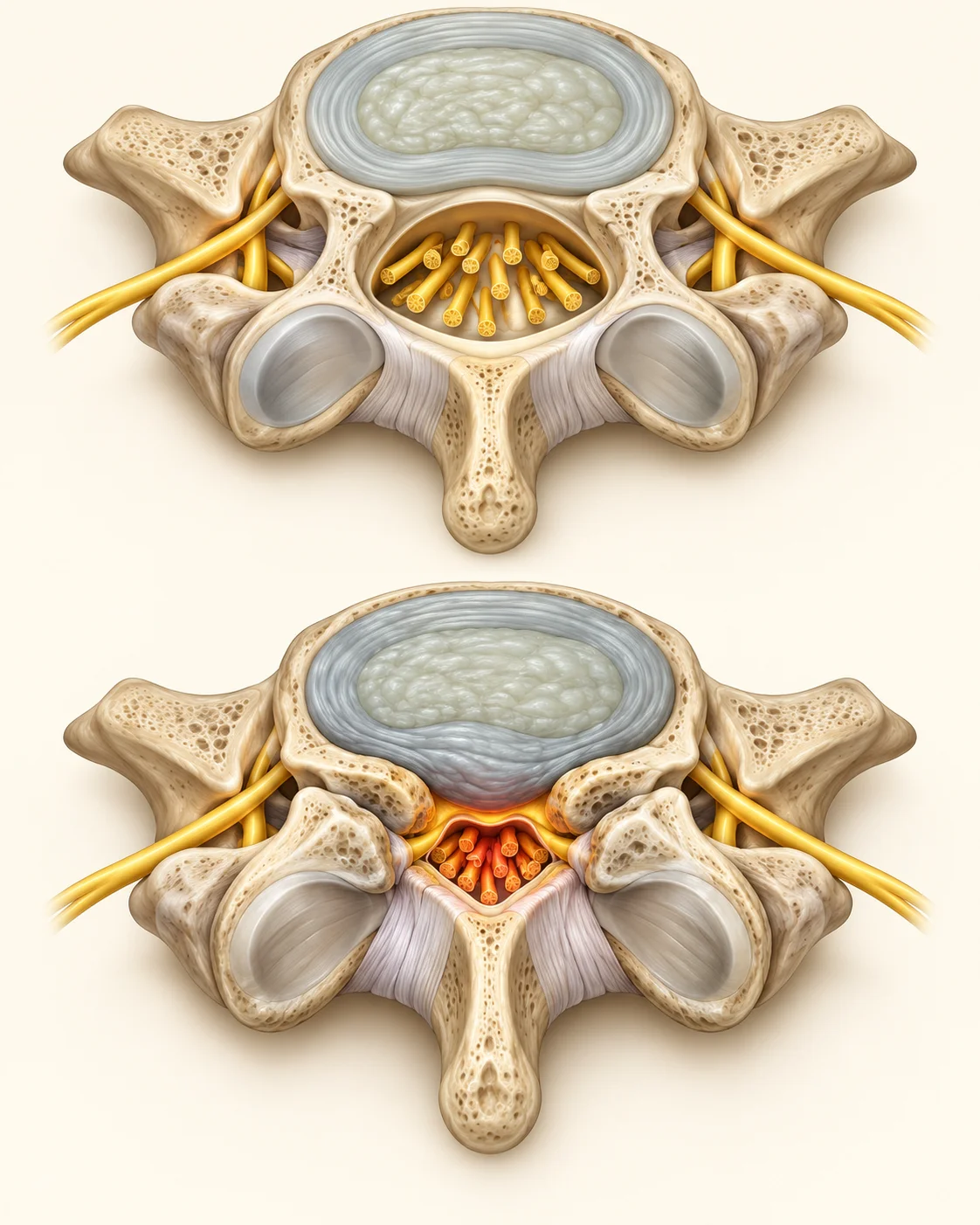
The main spinal canal becomes narrower through a combination of bone overgrowth, a bulging disc and thickened ligaments. Several nerve roots may be compressed, causing symptoms in both legs. A vertebral slip (spondylolisthesis) can also reduce the available space.
Lateral recess stenosis
The lateral recess is the side of the spinal canal where a nerve root travels towards its exit opening. Bone overgrowth, sometimes combined with a bulging disc, can compress this nerve and cause sciatica on the same side.
Foraminal stenosis
The neuroforamen is the small opening on either side of the spine through which a nerve exits. Narrowing of this opening compresses the exiting nerve. Because this tunnel is already small, relatively limited narrowing can cause radiating leg pain.
What causes spinal stenosis?
Spinal stenosis is usually linked to age-related wear in the lower back and is more common after the age of fifty. Several changes can contribute:
- Wear of the intervertebral discs and small facet joints, with bone overgrowth that gradually reduces the space for nerves
- Bulging discs and thickened spinal ligaments
- Spondylolisthesis, where one vertebra slips relative to another and narrows the canal
- Local swelling after a minor strain in an already narrow lateral recess, which can bring on nerve symptoms
- Less commonly, a spinal canal that is narrow from birth, with symptoms developing later in life
How is spinal stenosis treated?
Leaning forward slightly increases the space within the spinal canal. A walker or rollator supports the arms and allows a comfortable forward-bent posture, which can improve walking without tiring the trunk muscles as much.
Epidural injections do not remove bone overgrowth or widen the spinal canal. They should not be described as a cure for the structural narrowing.
Surgical decompression aims to create more room for compressed nerves. Depending on the location of the narrowing, this may involve widening the spinal canal, the lateral recess or the nerve's exit opening.
Where endoscopic decompression may fit
Full-endoscopic decompression can widen the narrowed spinal canal through a small surgical approach in selected cases.
Endoscopic widening of the neuroforamen can relieve pressure on an exiting nerve when the narrowing is at the nerve opening.
The treatment approach depends on the location of the narrowing, the symptoms and the individual assessment.