
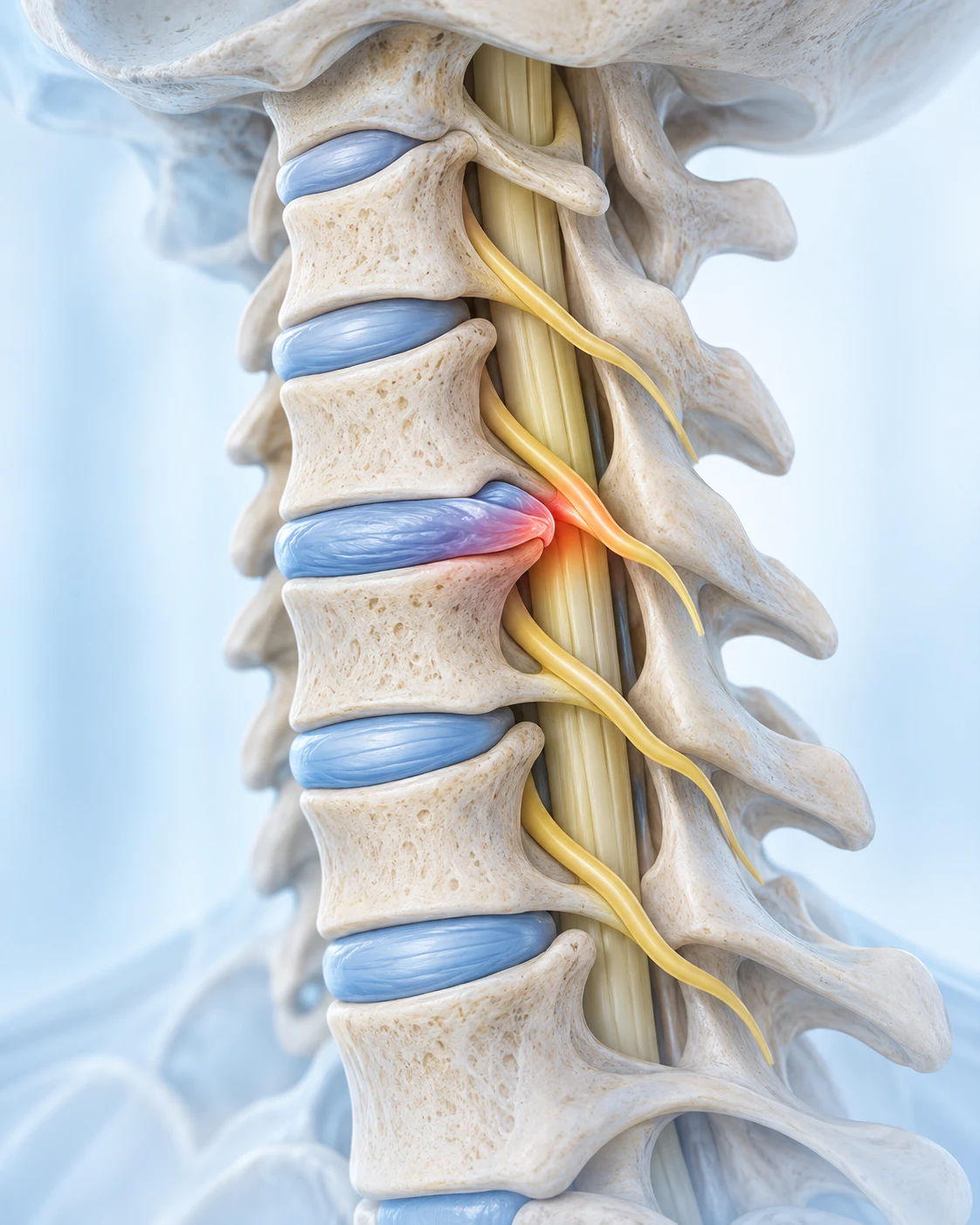
In brief
The clearest symptom is often pain that travels into one arm, rather than neck pain alone.
Tingling, numbness or weakness can occur when a nerve is irritated.
A scan finding only matters when it fits the symptoms and examination.
What are the symptoms?
Symptoms depend on which nerve is affected and how much it is irritated. They are commonly felt on one side and may include:
- Pain from the neck or shoulder blade into the shoulder, arm, hand or fingers
- Sharp or burning pain that may worsen with coughing, sneezing or certain neck movements
- Tingling, numbness or reduced feeling in part of the arm or hand
- Weakness in the shoulder, arm, hand or fingers
Some people first notice sudden neck pain or a stiff neck. The neck pain may settle while arm pain appears later. Neck pain can also come from tense muscles around the painful area, so neck pain alone does not prove that a disc is pressing on a nerve.
Seek urgent medical help for new neurological changes
Get urgent medical advice if weakness is new or getting worse. Go to emergency care for sudden major weakness, worsening balance or walking, loss of hand control, new bladder or bowel changes, or numbness around the genital or saddle area. These can be signs of pressure on the spinal cord.
What is a herniated disc?
A disc sits between each pair of vertebrae and cushions movement. It has a firm outer ring and a softer, gel-like centre.
A herniation forms when some of the soft centre pushes through a tear in the outer ring. If it irritates a nearby nerve, pain or other symptoms can travel into the arm. A herniation that does not affect a nerve may cause neck pain only—or no symptoms at all.
Herniated disc or bulging disc?
Herniated disc
A more focused piece of the soft centre pushes through a tear in the outer ring.
Bulging disc
A broader part of the disc extends outward. Mild bulging is common with age and often causes no symptoms.
What can cause it?
A cervical disc herniation is often linked to gradual changes in the disc. Sometimes there is no single event that explains it. Factors can include:
- Normal age-related wear, which makes a disc less flexible
- An inherited tendency to develop disc problems
- Smoking, which can speed up disc degeneration and slow healing
- A sudden strain, twisting movement or injury to an already weakened disc
Diagnosis is more than a scan
The diagnosis comes from three parts that should tell the same story:
01
Your symptoms
Where the pain begins, where it travels and what makes it better or worse.
02
Examination
Strength, feeling, reflexes, hand function, balance and neck movement are checked as needed.
03
Imaging in context
An MRI or CT scan is compared with the symptoms and examination—not read in isolation.
A scan report is not a diagnosis on its own
Disc bulges and herniations can appear on scans in people who have no arm pain. Treatment should not be based only on words in an MRI or CT report.
What treatments are available?
Treatment usually begins without surgery. The aim is to reduce arm pain, protect nerve function and help you return to normal activity. A plan may include suitable pain relief, gentle activity and physiotherapy. Long periods of bed rest are generally not recommended.
If pain remains severe, a carefully selected patient may be offered an image-guided injection around the irritated nerve to reduce inflammation and pain. The effect can be temporary and the benefits and risks should be discussed first.
Surgery may be considered when pain remains disabling despite appropriate treatment, or sooner when weakness is progressing or the spinal cord is affected.
Where endoscopic surgery may fit
In selected cases, full-endoscopic cervical discectomy can remove the part of the disc pressing on a nerve through a small approach.
Because the whole disc is not routinely removed, motion can often be preserved and a fusion or artificial disc may be avoided.
It is not suitable for every disc herniation; the location of the problem, spinal stability and the full clinical picture decide which operation is safest.
Common questions
No. A bulge is usually broad, while a herniation is a more focused escape of soft disc material through the outer ring. Either finding may be painless if no nerve is irritated.
Scans often show age-related disc changes in people without symptoms. The finding must match the side and pattern of the pain and the clinical examination.
No. It can preserve the disc in selected patients, but some patterns of compression, instability or spinal cord disease need a different approach.